
Transmotor-Flywheel-Ultracapacitor Powertrain for Vehicle Applications
Battery Electric Vehicles (BEVs) can recuperate the kinetic energy of the moving vehicle by the process of regenerative braking. However, this feature is limited by the battery recharge power rating which often is significantly less than the BEV propulsion power rating. Moreover, the Li-ion battery technology that is commonly used in commercial BEVs, are limited by thermal constraints for safety reason. Furthermore, the Li-ion battery's State of Health (SOH) could be noticeably affected by utilizing regenerative braking in harsh braking scenarios. This article is an attempt to alleviate some of the summarized battery technology shortcomings.
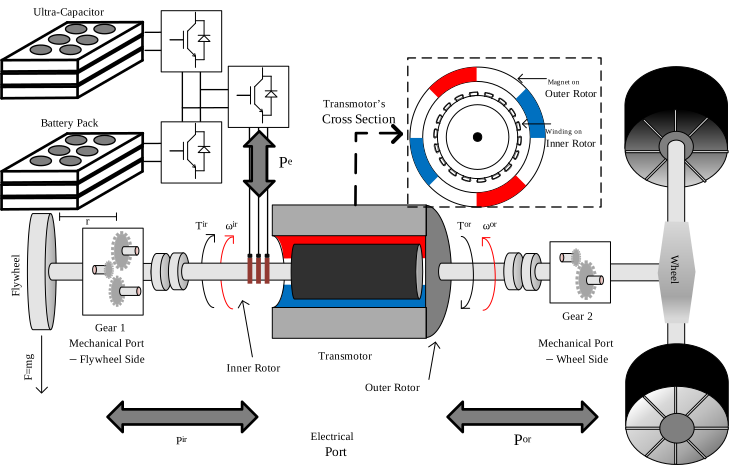
In this research, various transmotor-based powertrains are reviewed, and their advantages and possible limitations are summerized. Next, based on previously published articles, the transmotor-flywheel powertrain assisted with an ultracapacitor is proposed. This powertrain is capable of improving regenerative braking significantly by utilizing a lightweight flywheel and a small ultracapacitor pack as dual power sources. In order to connect the flywheel and ultracapacitor to the driveshaft effectively and more efficiently, a two-shaft electric motor called the transmotor is utilized. Further, the proposed powertrain, transmotor-flywheel assisted by ultracapacitor, enables us to reduce the power rating of the battery pack to the extent that it only be used for low power demand loads such as cruising and as a energy source.
Various braking scenarios, from harsh to mild vehicle braking, in regenerative mode, are simulated and presented to show possible regenerative braking enhancement. Finally, the developed prototype, utilized to explain the powertrain power flow and control algorithm, is explained.
Simulation Scenario's Criteria
Vehicle Deceleration (Braking) Scenarios:
- Braking Scenarios from mild braking to harsh braking
- The vehicles decelerate from their initial speed (60 mph) to stand still.
- Next, the vehicles accelerate from standstill to their initial speed (60 mph).
- Each vehicle tries to recuperate as much as possible.
Vehicle's acceleration/deceleration intensity:
- Scenario 1 (Mild): in 16 seconds
- Scenario 2 (Mild to Moderate): in 12 seconds
- Scenario 3 (Medrate to Harsh): in 8 seconds
- Scenario 4 (Harsh): in 4 seconds